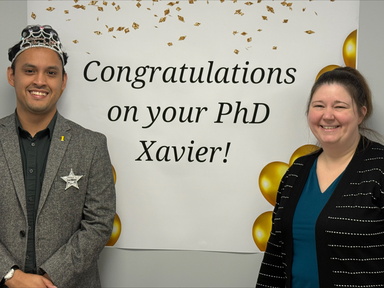
Xavier Tijerina, a Ph.D. candidate, successfully defended his thesis titled “Getting Around: The Multifunctional Role of Chlamydia trachomatis Effector CpoS” on Thursday, December 11, 2025. He is pictured alongside his mentor, Professor Mary Weber.
Research
Chlamydia trachomatis (C.t.) is the causative agent of the sexually transmitted infection (STI) chlamydia. Chlamydia infection is often asymptomatic, which leads to delayed treatment, and is associated with severe gynecological outcomes including pelvic inflammatory disease, sterility, and an increased risk of cancer.
C.t. is an obligate intracellular pathogen, meaning it relies on a host cell to replicate and establish an infection. C.t. uses numerous proteins, known as effectors, to facilitate its developmental cycle from within the inclusion, a membrane bound compartment. Several of these effectors, termed inclusion membrane proteins (Inc), embed themselves into the inclusion where they can interact with host proteins. In this work, we have revealed the many interactions of the Inc CpoS. We show that CpoS binds to host Rab proteins, which control movement of cargo within a cell, and other Incs to assist them with their interactions. We show that these interactions occur at separate locations on CpoS. In addition, we uncovered a novel interaction between CpoS and the host protein VAMP8. VAMP8 promotes the fusion of membrane compartments with the lysosome, a degradative organelle. The CpoS-VAMP8 interaction relies on a portion of the protein that overlaps both the Rab and Inc binding regions, suggesting CpoS likely has signals to promote specific interactions over others based on the needs of the growing bacterium.
Together, these results show that C.t. uses proteins that can serve multiple purposes to successfully establish infection within a host.
Background
Xavier was born in San Antonio, Texas with his twin sister Gabrielle also attending. As a child with pyloric stenosis and yearly bouts of pneumonia, he grew up very familiar with the medical field.
Staying close to home, Xavier attended St. Mary’s University, roughly ten minutes from his father and grandparents. He spent many weekends home, enjoying the company of his many siblings, and appreciating the role he has as an older brother. Xavier majored in Biology and began working in the lab of Dr. Christine Gray studying the intracellular bacterium Wolbachia. Additional experiences learning how to characterize proteins with Dr. Colette Daubner and Dr. Yidong Bai further developed his interest in scientific research. However, medical school remained his goal.
One fateful summer, he attended the pre-MSTP research experience at the University of Iowa, working in the lab of Dr. Jon Houtman further developing his biochemical skills. There, he learned you could do both medicine and research. Iowa convinced him to see what a real winter was like, and in 2019, he joined the MSTP program. In summer 2020, he rotated in the lab of Dr. Mary Weber in the department of Microbiology and Immunology studying Chlamydia trachomatis. There, he was able to combine both his intracellular microbiology and biochemical experience into one project. He officially joined Dr. Weber’s lab in 2021 and dived fully into characterizing the interactions of the Chlamydia protein CpoS using countless immunoprecipitations and various microscopy techniques. After graduate school, Xavier will return to the clinic as a medical student with plans to continue research in residency.
When not in lab, Xavier enjoys time with friends, painting his miniatures, reading, or looking for estate sales nearby. He dedicates time to refining his dry humor and is eager to participate in any sporting activity.