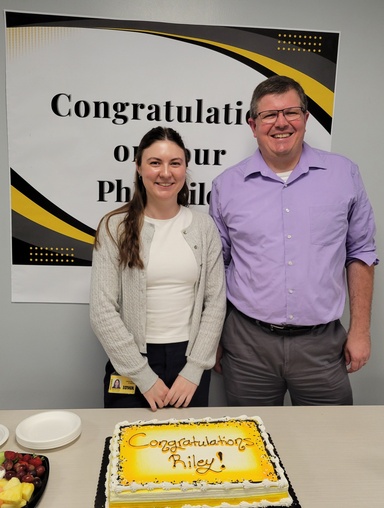
PhD candidate, Riley McFarlane, successfully defended her thesis, "Exploring the intersection of metal homeostasis and oxidative stress response gene regulation in Staphylococcus aureus", on Monday, April 13, 2026. She is pictured here with her mentor, Dr. Thomas Kehl-Fie.
Research
Microbes face a variety of changes and stressors in their environment that they must overcome to survive. Further complicating this matter is that these stressors often occur simultaneously and impose conflicting demands on the cell. Therefore, bacteria must carefully regulate the gene expression of their stress defenses to most efficiently employ cell resources. Two such conflicting threats imposed by the host immune system are metal limitation and oxidative stress. However, how bacteria coordinate a response to conflicting stressors is not well understood. The important human pathogen Staphylococcus aureus can be utilized to investigate how pathogens cope with multiple stressors, allowing them to circumvent the host immune system.
This work reveals how S. aureus coordinates a response to the dual threats of metal limitation and oxidative stress by fine-tuning the regulation of a conditionally essential metal-dependent enzyme. When faced with manganese limitation, the small RNA RsaC initiates a manganese-sparing response by suppressing the manganese-utilizing superoxide dismutase SodA. This response protects the cell from manganese starvation by subduing the cellular demand for manganese, thereby allowing for growth and virulence when manganese is scarce. However, this comes at a cost of superoxide detoxification and thus the benefit of RsaC is reduced in the presence of oxidative stress. Therefore, RsaC is caught at the intersection of metal starvation and oxidative stress response, in which it must delicately balance the preservation of essential manganese-dependent processes through manganese-sparing, with the maintenance of adequate oxidative stress defense.
Overall, this study uncovers a previously unappreciated manganese-sparing response that supports the growth and virulence of S. aureus. This work also emphasizes that microbes must fine-tune their responses in a way that balances critical and conditionally-essential cellular needs, as ultimately sometimes the response to one stressor comes at the sacrifice of another.
Background
Riley was born and raised in McKinney, Texas. The youngest of four sisters and surrounded by many pets of different species, Riley’s upbringing never lacked excitement. Her love for her animal companions, along with her observation of her mom’s nursing career, fostered an early interest in biology.
This interest led her to pursue veterinary medicine, first by majoring in biological sciences at the Missouri University of Science and Technology. Here, she competed on the university’s first women’s golf team, as well as discovered her passion for microbiology. All it took was one microbiology course with a talented professor who effectively illustrated the importance, intricacy, and intrigue of microorganisms. This inspired her to participate in microbiology research and take additional microbiology courses, where her love for the topic continued to grow and eventually led her to pursue a career in microbiology. With a fondness for clinical medicine from her veterinary science background, she found the ideal career path: clinical microbiology.
To continue her path towards this career goal and further develop her understanding of microbiology, she began her graduate school journey at the University of Illinois at Urbana-Champaign in Dr. Thomas Kehl-Fie’s lab. Three years later, she moved with her lab to the University of Iowa to continue her thesis work. Her research has focused on studying the regulation of metal limitation and oxidative stress responses in Staphylococcus aureus. This work has resulted in a first-author publication as well as a second-author publication. Throughout her training, she has mentored several undergraduate students, presented at many conferences, and sought out clinical experiences. Following graduation, Riley will continue to explore the world of clinical microbiology by working in a clinical microbiology laboratory while she applies to fellowships in hopes of becoming a clinical microbiology laboratory director.
When not in the lab, Riley enjoys spending time with her dogs, Fergie and Stella, who have seen her graduate high school, college, and now graduate school. She also enjoys being outside on a nice day walking, golfing, or sitting on a patio with friends or family.